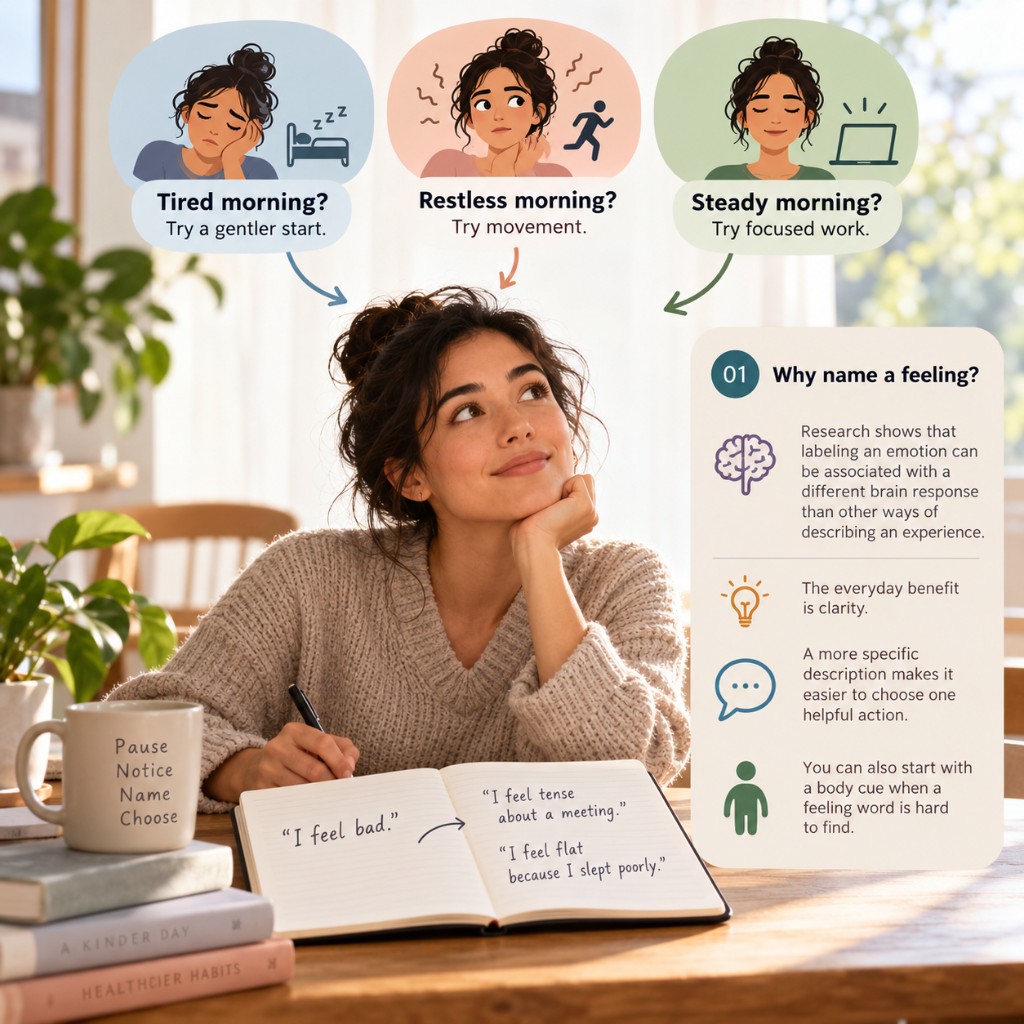

A single mood entry tells you how one moment felt. Several entries can reveal questions worth exploring: Are certain days more demanding? Does poor sleep tend to appear before low energy? When do you feel supported? Patterns can guide reflection, but they are not diagnoses or proof of cause.
Tracking is most useful when it helps you act with kindness. The aim is not to eliminate difficult emotions. Sadness, anger, and worry can be understandable responses to real events, and a chart cannot tell the whole story of a person.
Look for context before meaning
Choose a short review window, such as one week. Notice when entries cluster, then consider what else was happening: sleep, work demands, social contact, movement, illness, or a change in routine. A coinciding pattern does not prove that one thing caused another.
For example, a low mood after a short night may suggest that rest deserves attention. It does not prove that sleep alone explains the feeling. The NIH notes that clinicians sometimes use sleep diaries to understand sleep difficulties; a personal log can similarly help you remember context when seeking advice, but it is not a clinical assessment.
A gentle weekly review in Gruvium
Use Mood and your available insights as prompts for three questions, then pick one experiment.
- 1What happened more than once? Look for repeated situations, not a single dramatic day.
- 2What helped, even a little? Consider sleep, a walk, a Calm Center practice, a conversation, or a lighter schedule.
- 3What is one small change to try next week? Protect a wind-down window, shorten a Focus block, or reach out to someone you trust.
- 4Check again after several days. Keep, adapt, or drop the experiment based on how it fits your life.
Keep privacy and limits in view
Your mood notes can be personal. Write only what you want to keep, review your privacy settings, and avoid sharing a chart simply because an app makes it possible. If you use Gruvi AI to reflect, treat its suggestions as prompts to consider rather than clinical interpretations.
If you see severe or distressing symptoms lasting two weeks or more, or daily life becomes difficult to manage, the NIMH recommends seeking professional help. If you or someone else may be in immediate danger, contact local emergency services. App patterns can help you describe what has been happening, but a qualified professional can assess the wider picture.
Keep the experiment honest
Suppose you notice that Tuesdays often feel tense. Before changing your entire schedule, ask what Tuesdays share: a particular meeting, less sleep on Monday, or a rushed commute. Try one modest adjustment and observe the next two Tuesdays. If nothing changes, that is information too; your first explanation may have been incomplete.
Weekly review works best when it includes the ordinary good moments as well as difficult ones. Notice when you felt connected, rested, or absorbed in something meaningful. Those entries can show what deserves more space in your week without suggesting that every hard feeling should disappear.
Questions
Can a mood chart diagnose anxiety or depression?
No. A chart summarizes your entries. Diagnosis requires a qualified professional who can consider symptoms, duration, context, and other health factors.
What if tracking makes me feel worse?
Reduce the frequency, record less detail, or stop. A wellbeing tool should serve you; it is okay to choose another way to reflect.
Sources and further reading
These primary sources inform the general guidance above. The suggested Gruvium practices are optional ways to apply it.
This article is for education and everyday wellbeing. It is not medical advice or a substitute for care from a qualified professional.
By Gruvium Editorial